Arms or No Arms: Which Dining Chair Fits Your Outdoor Table?
Choose outdoor dining chairs with or without arms by comparing table clearance, chair footprint and how easily each seat moves around your patio.
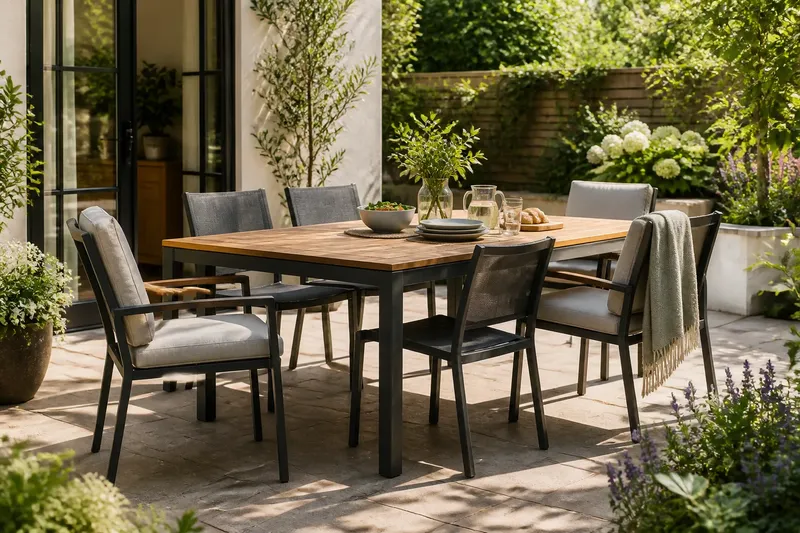
The most common mistake when choosing outdoor dining chairs is buying a style before checking how its arms meet the table. The cost is practical: a chair may look right beside the table yet refuse to slide beneath it, crowd a neighbour or feel awkward to pull out. Arms or no arms is best decided by the way people sit, move and share the space around your particular table.
Start With Table Clearance
Measure the space from the ground to the underside of the table edge, not just to the top. An armchair needs enough vertical clearance for its arms to pass beneath that edge; a thick apron, low frame or crossbar can make an otherwise generous table incompatible. An armless chair avoids the arm-height issue, though its seat and back still need room to move.
Also look at the table’s legs. A central pedestal can leave the perimeter open, while corner legs may occupy the very space where chair arms would sit. If an armchair has to be angled around a leg, it can become cumbersome to use even when it fits on paper.
Use the actual chair dimensions when comparing options. Product descriptions may give overall width, but the usable seat width and the widest point across the arms answer different questions. If possible, mark each chair’s footprint on the paving with masking tape or string and compare it with the table legs and the path people use to reach their seats.
For a close fit, consider the chair’s shape as well as its width. Curved arms can project beyond the seat, while a straight, narrow frame may sit more neatly at the table. A chair that fits when pushed in should still be comfortable to pull out without catching on a planter, wall or neighbouring seat.
Choose By Setting
The best choice changes with the setting. A dining area used for quick weekday meals has different demands from a large garden table where guests linger. Rather than treating armchairs as an upgrade or armless chairs as a compromise, match the form to how the seats will be occupied and stored.
For a compact balcony
Choose armless chairs if the table sits close to a railing, wall or door, or if several seats must share a narrow edge. Their simpler outline is often easier to tuck in, and a chair can be turned or shifted without its arms catching on nearby furniture. This is especially useful where people need to enter and leave from the same side.
Armchairs may still suit a balcony if the table is small, the seats are used by just one or two people, and the arms fit cleanly beneath the top. Check the route to the door with a chair pulled out, not only with every seat neatly pushed in.
For a generous patio
Choose armchairs when there is room around the table and diners often stay seated after the meal. The arms give the forearms a place to rest and can make a longer gathering feel more settled. They also give each seat a defined shape, which may suit a broad table with generous spacing between places.
Do not assume that a large patio makes every armchair suitable. Leave enough room for a person to pull the chair back and stand without pressing into a wall or another diner’s seat. A wide chair can reduce the number of comfortable places around the table even when the paving itself feels open.
For a table used by many people
Choose armless chairs when the number of diners changes often or the table needs to take an extra seat now and then. Their narrower profiles can make it easier to rearrange the group, although the table’s leg positions and the chairs’ actual widths still set a limit. For regular large gatherings, check that the table has usable seating space along each side rather than counting places from the tabletop alone.
For long, relaxed meals
Choose armchairs if the chairs are comfortable for the people who use them and the available clearance accommodates their frames. Arms can support a relaxed posture, but they do not compensate for a seat that is too deep, a back that feels uncomfortable or a table edge that presses against the body. Try the chair at the table if you can, rather than judging it in a showroom arrangement without the tabletop.
Think About Movement
Armless chairs are generally easier to lift, turn and slide between a table and a neighbouring seat because there are fewer projecting parts to catch. That can matter on uneven paving, beside a timber deck step or when chairs are routinely moved aside to make room for another use. A light chair may be convenient to reposition, but it should still feel stable when someone sits down.
Armchairs ask for more careful handling in a tight arrangement. Their arms can bump the table edge or neighbouring frames when someone draws them back. Yet a well-spaced armchair may be straightforward to move, and its arms can offer a useful grip when a person is sitting down or rising. The right choice depends on the user as well as the layout.
Imagine a small paved courtyard with a square table and one route through to the kitchen door. If its owner chooses four broad armchairs, the nearest chair may block the doorway whenever someone sits down. Replacing two of them with narrower armless chairs could leave the path clearer while retaining armchairs at the less constrained ends, where their extra width does not obstruct the route.
This mixed arrangement can work when the chair heights and visual style belong together. It may not suit a table with little space at its ends, or a household where every seat needs the same support. Treat it as one option to assess, not a rule that end chairs must have arms.
Compare The Trade-Offs
- Armless chairs: Choose them when space is limited, seats are often rearranged or a flexible seating count matters. Check whether the back and seat remain comfortable for the usual length of a meal.
- Armchairs: Choose them when there is ample clearance and a more supported, settled seat is a priority. Check arm height against the underside of the table and allow room for the full chair to move.
- A combination: Consider it when different positions around the table have different constraints. Check that the chairs do not crowd one another and that the arrangement still feels coherent to use.
Comfort is not determined by arms alone. Seat depth, back angle, surface texture and the height of the table all affect how a chair feels. If several people will use the dining area, ask the regular diners to sit in the chair and approach the table as they would at home. A comfortable chair is one that suits the body and the way the seat is used, not simply the one with the most features.
Outdoor materials also affect the routine of moving and caring for chairs. Metal frames can feel firm and may be easy to wipe, while timber and woven materials have their own textures and maintenance needs. Cushions add comfort but need a place to be kept when not in use. Follow the maker’s care guidance for the chair and any cushion fabric, since appropriate cleaning and storage vary by material.
Questions Before Choosing?
How do I know whether chair arms will fit under my table?
Compare the height of the arms with the clearance beneath the tabletop, including any apron or frame. Check the chair at the position where it will be used, because table legs can interfere even when the arms clear the edge.
Are armless chairs better for a small outdoor dining area?
They are often easier to fit and reposition, so they can be a sensible choice when space is restricted. Confirm that the chair can still be pulled out without blocking a doorway or pinching the route around the table.
Can I mix armchairs and armless chairs around one table?
Yes, if the mix answers a real difference in clearance or comfort and does not make particular seats awkward to reach. Compare the seat heights and overall scale, then check each position in use rather than relying on a symmetrical arrangement.
Should every diner use the same type of chair?
Not necessarily. Some people may value arms for support, while others prefer the freedom to move an armless chair easily; the table must still have enough room for the combination.
Make The Final Choice
Before buying, check these details against the place the chairs will occupy:
- Table clearance: If arms do not pass beneath the edge, choose armless chairs or a different table-and-chair pairing.
- Leg positions: If a chair catches on a table leg, compare another frame shape or reserve that position for a better-fitting chair.
- Room to pull out: If a drawn-back chair blocks a door or passage, choose a narrower footprint or change the seating arrangement.
- Movement needs: If chairs are moved frequently, favour the shape that is easiest for the regular users to lift, turn or slide.
- Time spent seated: If meals are long, prioritise a comfortable fit at the table; arms help only when their position suits the diner.
- Care routine: If cushions or delicate finishes are part of the choice, decide where they will be stored and how the maker recommends caring for them.
For a compact outdoor dining area, armless chairs usually make the more adaptable starting point. For a roomier table used for lingering meals, armchairs are often the more comfortable fit. If the outdoor dining chairs must serve different people and positions, compare a mixed set against the actual table and route before deciding; the useful distinction is not style, but whether each seat fits its place and its user.