Why More Pots Do Not Always Make a Better Display
A considered patio pot display gives each container room to register, helping you choose a clearer arrangement and let plant shapes and finishes stand apart.
The most common mistake in a patio pot display is adding another container whenever a corner looks unfinished. That can cost the arrangement its breathing room: foliage overlaps, outlines blur and the pots lose their individual character. Before adding anything, decide what each container contributes to the view.
Read the arrangement
A pot contributes more than a place for a plant. Its outline, colour, surface and height all shape the display. When several containers sit close together, their rims, leaves and shadows compete; with a little separation, their differences become easier to see.
Even spacing is not the goal. Instead, consider how the forms relate: a tall container might sit slightly behind a low, broad one, while an open patch of paving keeps their profiles distinct. The useful arrangement depends on the view from the doorway, window or usual seat, not on a fixed pattern seen from above.
Set a focal point
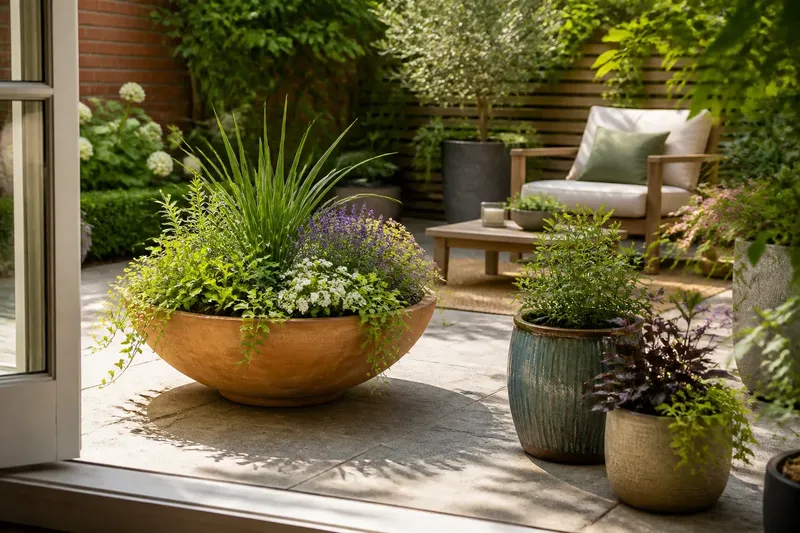
Choose the container with the strongest presence, such as a broad terracotta bowl, a tall glazed cylinder or a weathered stone planter. Give its shape a clear role in the composition. Smaller pots can support it through a related colour or material, while a contrasting finish adds interest without requiring every container to compete.
Imagine a patio door opens on to a wide terracotta bowl and three smaller pots, with leaves hiding much of the bowl’s rim. The starting point is that four-pot group, viewed from the doorway. Move two small pots to a separate part of the patio, then rotate the remaining one until its profile no longer overlaps the bowl; the resulting view should make the bowl’s outline easier to read, though the smaller grouping may feel less abundant.
Compare surfaces
Terracotta has an earthy, porous appearance; glazed ceramic catches light; metal gives a sharper edge; timber often feels softer beside paving. If several finishes press together, their contrasts can look accidental. Repeating one material or colour in separate parts of the patio can connect the spaces without gathering every pot in one corner.
Notice the surface behind and beneath each container. A dark pot may stand out against pale paving, while a warm pot can sit quietly beside brick or timber decking. Not every container needs to be a feature: a restrained finish can give a more distinctive planter room to draw attention.
Account for foliage
Judge the plant and pot as one shape. Trailing leaves extend the display beyond the rim; upright grasses and compact shrubs produce different outlines. Plants that touch now may merge as they grow, so check the care label or ask the supplier about mature form when it affects where you can place them.
A simple layout check can help you decide what to keep together:
- Observe whether pot rims overlap from the main doorway; if they do, separate or rotate one container, and if they remain distinct, keep the current positions.
- Observe whether leaves hide a pot’s surface; if they do, reposition the plant or give the container more room, and if the material remains visible, retain the grouping.
- Observe whether two finishes compete; if they do, move one pot elsewhere or repeat a shared colour, and if one finish quietly supports another, leave them together.
- Observe whether foliage is already touching; if it is, allow more space or choose a different position, and if the plant outlines remain separate, keep the spacing.
- Observe whether the focal container is visible from your usual seat; if it is obscured, change its position, and if its form reads clearly, preserve that sightline.
- Observe whether the display blocks a clear route across the patio; if it does, move a pot out of the way, and if the route remains open, keep the layout.
Questions about patio pot displays?
How many pots should sit together?
There is no single number that suits every patio. Keep together only as many as remain distinct from the places where you usually view them.
Should patio pots match?
They need not match, but one repeated material, colour or shape can make the group feel related. Let other details vary where they do not compete for attention.
Where should a large pot go?
Place it where its scale relates comfortably to a wall, doorway or seating area. Leave its outline visible and avoid using smaller containers to crowd its edges.
What if the patio still looks bare?
Check whether the existing display is positioned where it can be seen before adding another container. A pot that is better placed may give the space more definition without making the paving feel crowded.
Keep useful space
When the display feels unsettled, look for a specific cause rather than treating every empty patch as a problem. Overlapping rims, hidden surfaces, merged foliage and an obstructed route each call for a different adjustment. Keeping a spare pot elsewhere is a considered choice, not a failure to fill the patio.
A successful patio pot display lets plant forms and container materials remain legible while leaving the space comfortable to use. When deciding whether to add a pot, weigh its contribution against the room, sightlines and clear route the existing arrangement needs.